Supreme Court’s verdict on sub-classification of SCs and STs for Reservation
While the intention behind sub-classification is to promote fairness, its execution and long-term impact remain contentious. Ensuring that this policy is backed by robust data and implemented with careful monitoring will be crucial. Otherwise, it could end up dividing communities, creating new disparities, and complicating the reservation system rather than improving it.
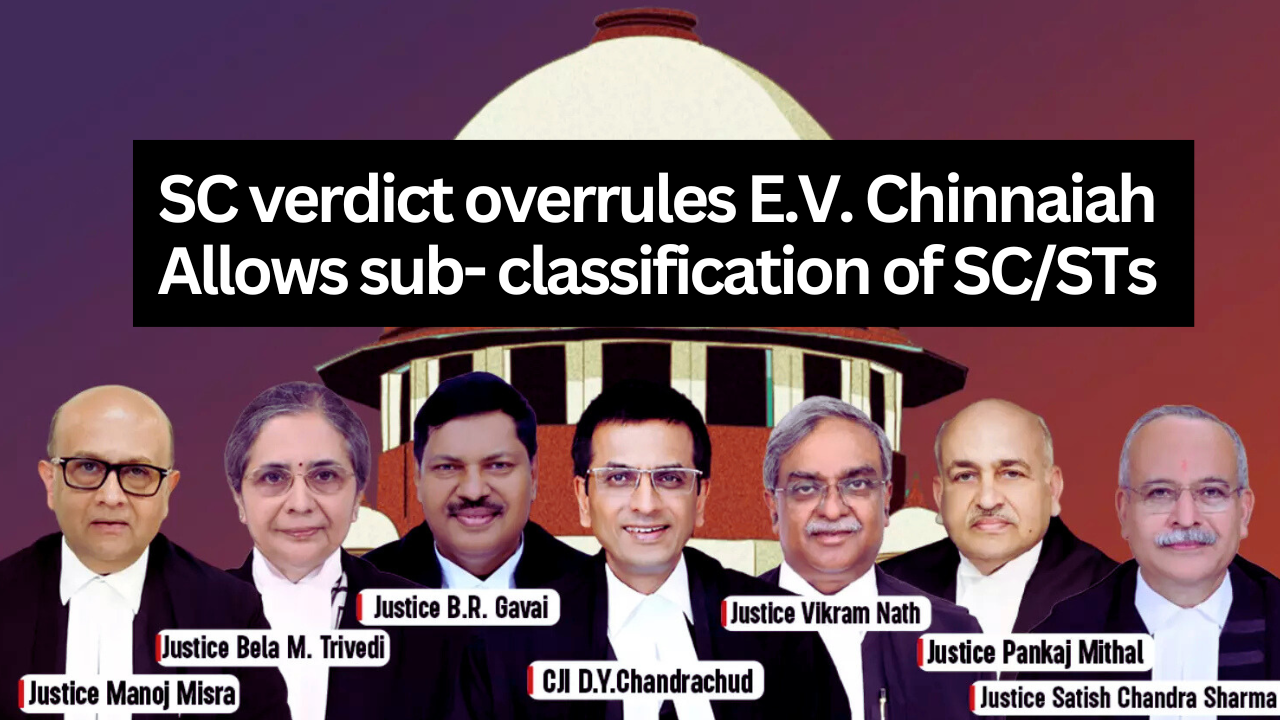
In a landmark decision on August 1, 2024, the Supreme Court of India ruled that state governments can sub-classify Scheduled Castes (SCs) and Scheduled Tribes (STs) to ensure equitable distribution of reservation benefits among these communities. This 6:1 verdict by a seven-judge Constitution Bench, led by Chief Justice of India D.Y. Chandrachud, overturns the Court’s 2004 judgment in the E.V. Chinnaiah case, which had held that SCs and STs are homogeneous groups that cannot be further subdivided for quotas.
Key Highlights of the Verdict:
- Sub-classification Permissible: The Court held that sub-classification within SCs and STs is constitutionally permissible to ensure that the benefits of reservation reach the most marginalized within these communities. This acknowledges the varying degrees of social and educational backwardness among different castes within the SC and ST categories.
- Requirement of Data: States must base any sub-classification on “quantifiable and demonstrable data” to ensure that the process is not arbitrary and is rooted in empirical evidence.
- Overruling of 2004 Judgment: The decision overturns the 2004 E.V. Chinnaiah judgment, which had held that SCs and STs are homogeneous groups that cannot be subdivided for reservation purposes.
- Creamy Layer Consideration: Some justices suggested that the “creamy layer” principle, which excludes the more affluent members of backward classes from reservation benefits, should be applied to SCs and STs. Justice B.R. Gavai emphasized that states should identify and exclude the creamy layer within SCs and STs to ensure that reservation benefits reach the truly disadvantaged.
- Dissenting Opinion: Justice Bela M. Trivedi dissented, arguing that states should not alter the Scheduled Caste list notified under Article 341 of the Constitution. She maintained that any sub-classification would amount to tinkering with the Presidential list, which is beyond the purview of state governments.
Implications of the Verdict:
This ruling empowers state governments to create sub-categories within SCs and STs to ensure that reservation benefits are more equitably distributed, especially to the most marginalized groups. However, any such sub-classification must be backed by empirical data and is subject to judicial review to prevent misuse or arbitrary decisions. The suggestion to apply the creamy layer principle to SCs and STs could lead to significant changes in how reservation policies are implemented, potentially excluding more affluent individuals within these communities from availing reservation benefits.
Violation of the Constitution’s Framework
- Critics argue that sub-classification may violate Article 341 and Article 342, which provide for a single Presidential list of Scheduled Castes and Tribes. Any sub-classification could be seen as an alteration of this list, which only Parliament can do.
- Justice Bela M. Trivedi, in her dissent, emphasized that allowing states to sub-classify could disturb the homogeneity of SCs and STs and go against the spirit of the Constitution.
Risk of Political Misuse
- There is a fear that sub-classification could be used for political gains by favoring certain sub-groups over others, leading to divisive policies.
- This might create rivalries and conflicts among different sub-castes, weakening the solidarity within SC/ST communities.
Implementation Challenges
- Sub-classification would require extensive data collection to justify the division of benefits, which may take years. The lack of accurate and updated data on social and educational backwardness among sub-castes could lead to arbitrary decisions.
Exclusion of Vulnerable Groups
- The introduction of the “creamy layer” principle within SCs and STs is a controversial idea. Critics say that it could deprive genuinely deserving individuals who may appear affluent but continue to face social discrimination.
- This principle might also disproportionately affect better-organized communities within SC/STs while leaving the most vulnerable with little support.
Impact on the SC/ST Community
Positive Impact: Equitable Distribution of Benefits
- The verdict could help the most marginalized sub-groups within SCs and STs—those that historically received fewer benefits—gain access to educational, employment, and political opportunities.
- It promotes substantive equality by addressing the internal inequalities within SC/ST groups.
Increased Fragmentation
- There’s a risk of fragmentation within the community, where sub-castes might start competing against each other for a share of reservation benefits.
- It could create new hierarchies and social divisions, which might weaken the collective political voice of SC/ST communities.
Complexity in Reservation Policies
- Sub-classification will make reservation policies more complex, requiring continuous data collection, regular revisions, and judicial scrutiny. This could lead to delays in policy implementation and legal battles.
Potential Reduction of Benefits
- If the creamy layer principle is applied, a significant portion of the SC/ST population could be excluded from reservations, reducing their share of benefits.
- This could be seen as eroding constitutional safeguards meant for SCs and STs and might widen existing inequalities instead of reducing them.
While the intention behind sub-classification is to promote fairness, its execution and long-term impact remain contentious. Ensuring that this policy is backed by robust data and implemented with careful monitoring will be crucial. Otherwise, it could end up dividing communities, creating new disparities, and complicating the reservation system rather than improving it.
Comments



Leave a Reply