
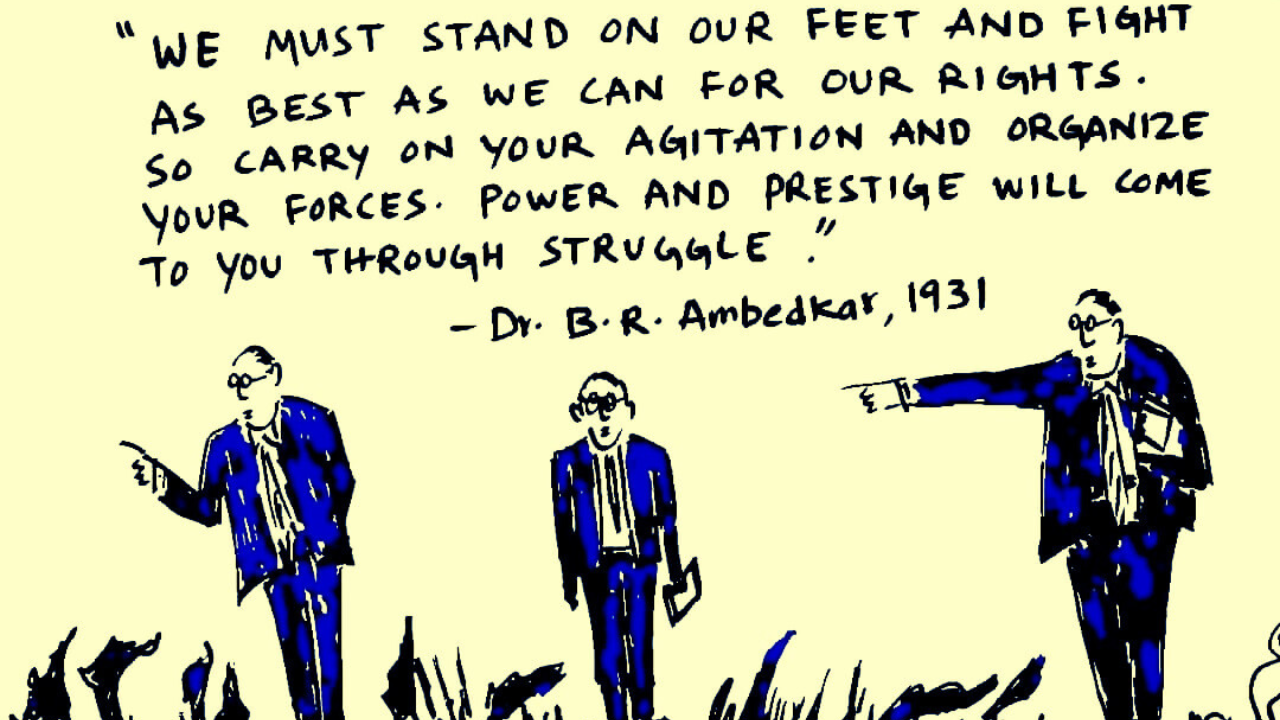
Ambedkar and Social Revolution
Ambedkar acknowledged the significance of force in every social revolution. However, this has been an unexplored aspect of Ambedkar in the Ambedkarite discourse and movement so far. Ambedkar, given limited opportunities, left anything unexplored, any door unknocked for the liberation of the oppressed.
In India, Ambedkar dealt with the structure of graded inequality and oppression based on social status and religion. The predominance of private property that has been a universal factor of social oppression all over the world took a different form in the context of India. Indian subcontinent took a different path with the intersection of religion, caste and private property, resulting into a unique system of social oppression where the superimposition of social status (caste) over the private property was established. The social degradation which was supposed to follow the economic degradation of private property, in fact, opened the door for all kinds of oppression and became an independent factor of exploitation. The religion which played an auxiliary part of the social oppression in other parts of the world performed a predominant role, determining even the political-economy and every structure of social oppression for ages. In fact, it emerged as a political philosophy of the Indian ruling class with the purpose of perpetuating social inequality, oppression and degradation. The fixed hereditary social status based on graded inequality of vertical order was designed not only to make the oppressed part of the social oppression, rather to retain the structure of social oppression fixed and unchanged forever. That’s how Brahmanism became one of the most complex structures of social oppression ever the humanity experienced which made revolution almost impossible till date.
These conditions made Ambedkar unique and different from other revolutionaries of his time in terms of understanding the nature of social oppression vis-a-vis the methods of social revolution. Those countries where private property remained the predominant factor of social oppression dividing people into two major classes of rich and poor, revolutionaries advocated direct methods of expropriation of private property through a violent revolution as preconditions of social revolution. However, for Ambedkar, the ideas of expropriation of private property through force and violence as a precondition of social revolution loses its importance unless the oppressed are aware about the cause of their oppression or make a common front or freed themselves from the hegemony of the Brahmanism that keeps them in a perpetual state of complete alienation from their organic self, desire and freedom. According to Ambedkar, Brahmanism as social structure based on the graded inequality with ascending scale of reverence and a descending scale of contempt, the oppressed are made to view each other in terms of high and low social status. Hence, to Ambedkar, the expropriation of the Brahman agency that makes them to see in hierarchy becomes the pre-condition of any social revolution in India. Religion i.e. Brahminism (as Hinduism) having the ultimate source of power for the Indian ruling class, and the prime reason of cultural hegemony and alienation can’t be expropriated through force and violence. Therefore, Ambedkar had to reinvent the methods and legacy of the anti-caste revolution in India i.e. religious conversion of the socially oppressed as a potent means to counter Brahmanism. The anti-caste movement and revolution from Buddha to Ravidas, Ghasidas, Tukaram, Bhim Bhoi, Ayothidasa adopted conversion as an important means for the liberation of the oppressed; particularly to counter the structure of graded inequality among the oppressed to make a common front at one hand and on the other hand, to bombard the power house of Indian ruling class i.e. religion that empowers the Brahminical ruling class to derive legitimacy and control over the oppressed. Hence conversion occupies the first and foremost place in the discourse of anti-caste struggle and Ambedkar theory of social revolution. Therefore, conversion holds as important place to Ambedkar as violent revolution to Marx and Lenin.
However, Ambedkar knew that conversion alone cannot emancipate the people from their historical oppression. He understood conversion more as a means than end in itself. Brahmanism, both as political philosophy and religion has historically shaped its social relations: cultural, economic and political. Therefore, most of the lower caste people happened to be the lower classes, historically living through intense poverty, landlessness, acute vulnerability and insecurity. They have been the eternal proletariat and main labour force throughout the journey of Brahmanism from the times of Manu to Modi. Besides, Brahmanism has proved to be so dynamic in appropriating and assimilating not only the anti-Brahminical or organic counter cultures (arming itself with people’s art and being more and more mass oriented and pervasive) but also all new political challenges those crossed its path from Islamic invasion to British colonialism, parliamentary democracy and capitalism, however retaining its social relation intact. Hence conversion can affect only the cultural aspect of Brahmanism, but the political-economic structure of Brahmanism will continue to oppress the masses. Conversion was meant to bring a revolutionary consciousness among the masses to organize themselves to fight for the political and economic restructuring of the society without which the program of annihilation of caste will remain incomplete. Therefore, Ambedkar firmly believed that without reconstructing the social economy, the evils of private property (other pillar of Brahmanism) cannot be eliminated. Therefore, in his writing, State and Minorities (a draft Constitution for India before independence), he proposed for state socialism to annihilate the entrenched social relation of Brahmanism. Ambedkar designed a unique variant of socialism similar to what Soviet Russia adopted under the leadership of Lenin. According to Ambedkar, it shall be the obligation on the state to plan the economic life of the people. It would be the state responsibility to provide capitals necessary for the agriculture and industry. Ambedkar wanted all major industries to be controlled by the state and land must be divided among the landless on the basis of collective farming. As per the plan, “the state shall divide the land acquired into farms of standard size and let out the farms for cultivation to residents of the village as tenants (made up of group of families) to cultivate.” The agriculture industry must be organized in such a way that there should be no landlords and no landless laboures. He was of the opinion that the scheme shall be brought into operation as early as possible but in no case shall the period extend beyond the tenth year from the date of the Constitution coming into operation.
However, after independence, the liberal and orthodox Indian ruling class under the leadership of Nehru adopted mixed economy (a variant of capitalism) as its economic model. By doing this, Nehru killed three birds with a single bullet; retained a Gandhian flavor, pushed Indian capitalism upward with public funds and appeased both the super powers, former USSR and USA and retained a socialist image internationally. Nothing surprising to Ambedkar, he knew that the kind of economic model he proposed has never happened in the history of parliamentary democracy. In fact, Ambedkar criticized parliamentary democracy for its failures in resolving economic inequality and oppression and favouring the interest of capitalist and bourgeois. That’s why he went to the extent of appreciating the importance of dictatorship of proletariat for a short period to establish socialism in his book, “Buddha or Marx”. Nevertheless, he never abandoned parliamentary democracy in favour of a dictatorial authoritative state for socialism the way Marx and Lenin did. He wanted to retain the best of ideas, political and economic arrangements the society has ever produced; without scarifying the ideals of a limited government, people’s sovereignty and liberty at one hand as well as socialism on the other. Hence, he proposed socialism under parliamentary democracy. He made a major amendment to the parliamentary democracy; firstly, he proposed State Socialism in the field of economic and secondly, he did not allow the establishment of State Socialism to the will of Legislature, thus made it unalterable by any act of the Legislature and the Executive. That is the ideal form of political and economic structure Ambedkar imagined and proposed for. However, Ambedkar had in mind the opposition and reservation from the liberals on the ground of overriding fundamental rights and liberty. In fact, this has been the universal position of liberals against socialism across the globe. Hence Ambedkar responded these liberals in the following words;
“For what is the purpose of prescribing by law the shape and form of the economic structure of society? The purpose is to protect the liberty of the individual from invasion by other individuals which is the object of enacting Fundamental Rights. The connection between individual liberty and the shape and form of the economic structure of society may not be apparent to everyone. None the less the connection between the two is real. It will be apparent if the following considerations are borne in mind” (States and Minorities, BAWS Vol 1: 409).
In counter, he explained how the liberal economy (capitalism) based on private enterprise violates the fundamental rights of the people;
“Ask those who are unemployed whether what are called Fundamental Rights are of any value to them. If a person who is unemployed is offered a choice between a job of some sort, with some sort of wages, with no fixed hours of labour and with an interdict on joining a union and the exercise of his right to freedom of speech, association, religion, etc., can there be any doubt as to what his choice will be… The fear of starvation, the fear of losing a house, the fear of losing savings if any, the fear of being compelled to take children away from school… are factors too strong to permit a man to stand out for his Fundamental Rights” (in the explanation of Article 2, Section 2(4), titled, Protection Against Violation of Fundamental Rights: Protection Against Economic Exploitation).
However, in spite his powerful articulation and a historic attempt ever made to incorporate socialism into the political democracy, he knew that it was hard to materialize through a social consensus due to the mutually antagonistic interests of both the oppressed and the oppressor. The oppressors will never be ready to sacrifice their power and privileges in fovour of the oppressed and socialism, rather they will die not to lose anything they have. If that is the conditions, then how to annihilate the socio-economic structure of Brahmanism or to establish socialism in a parliamentary democracy becomes a major problem. But Ambedkar had alternative method to resolve this social conflict.
Considering the irreconcilable difference between the oppressed and oppressors, Ambedkar never abandoned the method of applying force as a necessity for social transformation. Ambedkar acknowledged the significance of force in every social revolution. However, this has been an unexplored aspect of Ambedkar in the Amedkarite discourse and movement so far. Ambedkar, given limited opportunities, left anything unexplored, any door unknocked for the liberation of the oppressed, stating from writing constitution to resigning the post or social agitation to the social conversion. Unlike Lenin and Mao, Ambedkar, in spite having surrounded with all possible unfavorable conditions, lived a life full of countering the current, finding immediate solutions for many imperative issues affecting lives of the millions, never applied any existing theory or came up with a readymade approach of structured political events for social transformation, thus leaving his ideas dynamic and scattered. Beside, Ambedkar’s recognition of force as an essential element of social transformation is found in many of his writings. His engagement with the question of force happened mainly in the context of addressing the problems of political emerged in his time. Hence his ideas on these issues are contextual; where and whom he addressing to, whether an authority or oppressed nationalities or an ethical question or social necessity. For example, in the context of using force to suppress the rights of depressed classes and oppressed nationalities by the state and dominant forces, he discussed on the futility of applying force.
“The use of force alone is but temporary. It may endure for a moment, but it does not remove the necessity of subduing again; a nation is not governed which is perpetually to be conquered. The next objection to force is its uncertainty. Terror is not always the effect of force, and an armament is not a victory. If you do not succeed, you are without resource; for conciliation failing, force remains, but force failing, no further hope of reconciliation is left. Power and authority are sometimes bought by kindness, but they can never be begged as alms by an impoverished and defeated violence. A further objection to force is that you impair the object by your very endeavors to preserve it. The thing you fought for (with the loyalty of the people) is not the thing you recover but depreciated, sunk, wasted and consumed in the contest” (Ambedkar’s speech at the Plenary Session, Fifth Sitting of the Round Table Conference on 20th November 1930).
Similarly, in the context of Second World War, while criticizing the neutral position of Gandhi and Congress, Ambedkar addressed the question of war from the location of workers and marginalized against the Nazi Fascist camp:
“There are pacifists who argue that all wars are wrong. They argue that the troubles of the world are largely due to the wars that have devastated and defaced human civilization which men have built up at the cost of so much human effort. This is true. But in spite of all this, Labour refuses to accept pacificism as a principle of life. Wars cannot be abolished by merely refusing to fight when attacked. Peace obtained by surrender to the forces of violence is not peace. It is an act of suicide for which it is difficult to find any justification. It is a sacrifice of all that is noble and necessary for maintaining a worthy human life to the forces of savagery and barbarism” (Why Indian Labour is Determined to Win the War, BAWS Vol. 10: 39).
In the same context, he further said, “This war besides being a war is also a revolution—a revolution which demands a fundamental change in the terms of associated life—a re-planning of the society. In this sense it is a people’s war, and if it is not, it could and should be made into a people‘s war.” Similarly, on the issue of violence, he addressed while comparing Buddha and Karl Marx;
“As to violence there are many people who seem to shiver at the very thought of it. But this is only a sentiment. Violence cannot be altogether dispensed with. Even in non- communist countries a murderer is hanged. Does not hanging amount to violence? Non- Communist countries go to war with non-Communist countries. Millions of people are killed. Is this no violence? If a murderer can be killed, because he has killed a citizen, if a soldier can be killed in war because he belongs to a hostile nation why cannot a property owner be killed if his ownership leads to misery for the rest of humanity? There is no reason to make an exception in favour of the property owner, why one should regard private property as sacrosanct” (Buddha or Karl Marx, BAWS Vol. 4: 450).
Going beyond the Marxian concept of revolutionary violence, Ambedkar referred a conversation between Buddha and the Sinha Senapati, the commander Chief of Vaishali, where Budhha said, fighting for justice and safety cannot be accused of Himsa or violence at all. In another book, “The Philosophy of Hinduism” Ambedkar discussed the conditions of a revolution;
“The outbreak of a Revolution is conditioned by three factors. (1) The existence of a sense of wrong, (2) Capacity to know that one is suffering from a wrong and (3) availability of arms.”
In a speech to the Constituent Assembly while submitting the Draft Constitution, Ambedkar referred this subject. One of his famous and repeatedly quoted statements is; “the depressed classes are entering into a life of contradiction. In politics they will have equality and in social and economic life they will have inequality…. the state must remove this contradiction at the earliest possible moment or else those who suffer from inequality will blow up the structure of political democracy.” This was a direct warning call to the Indian ruling for a possible outbreak of a forceful revolution in India by the depressed classes.
Hence, in many instances, Ambedkar addressed the question of force for social transformation. In every instance, Ambedkar spoke from the location of the marginalized and oppressed. His support or condemnation on the use of force is conditioned on the premise of who is using it. According to Ambedkar, force can be applied to achieve some ends that are essential for the humanity, but while applying force, in the process, it should not destroy other ends those are worthy for the humanity. Hence, he discussed about controlling the force so that many ends of humanity can be saved. Hence, Ambedkar never conceived force as a matter of absolute principle. In his article, Mr Russell and the Reconstruction of Society, Ambedkar agreed with Professor Dewey, in applying force as energy to save as many ends for the humanity. This idea of saving as many ends of humanity inspired Ambedkar to rise above the ghettos of perspectives, negotiating and harmonizing the extremes; from socialism to parliamentary democracy or from religious conversion to forceful revolution. Besides, his thoughts on the questions of women and oppressed nationalities made his theory of social revolution so unique and dynamic. In fact, Ambedkar engaged more extensively on the question of women and oppressed nationalities than Lenin and Mao, two of his contemporaries. However, in a time, when Ambedkar has become the cap for every progressive and regressive forces and the state, with a view to counter or appropriate the pan-Indian Dalit upsurge around Ambedkar, this perspective might look unusual. Even inside the movement, many do not want to see Ambedkar the way he was. However, this is high time for the Ambedkarites to accept Ambedkar the way he was without getting obsessed and preoccupied with many of his decontextualised thoughts by choice or by conditions.
(Chinmaya Mahananda is an academic based in Odisha. He can be reached at mahanandchinmaya@gmail.com)




Leave a Reply